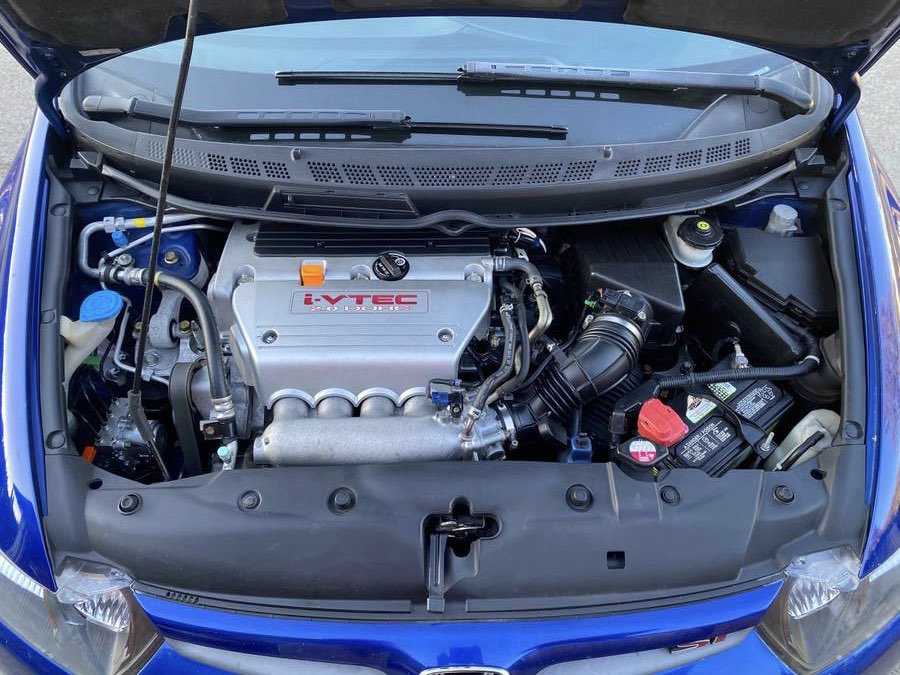
Honda's OBD2 implementation is well-regarded for its depth of data. Even with a generic ELM327 adapter, Honda ECUs expose a useful range of live data parameters. For full system access — including transmission, ABS and airbag modules — the Honda HDS (Honda Diagnostic System) software with a genuine HIM interface provides the most complete picture.
Honda OBD2 Port Location
On Honda Civic (7th generation onwards), Accord and CR-V models, the OBD2 port is located under the dashboard on the driver's side, typically near the steering column. On Honda Jazz (Fit) models it is positioned slightly further to the left. All Honda models from 1996 use the standard 16-pin OBD2 connector.
Honda-Specific Fault Codes
| Code | Description | Common Models |
|---|---|---|
| P0420 | Catalyst Efficiency Below Threshold | Civic, Accord, CR-V |
| P0740 | Torque Converter Clutch Circuit | Accord automatic, CR-V |
| P1259 | VTEC System Malfunction (Bank 1) | Civic Type R, Accord |
| P1361 | TDC Sensor 1 Intermittent | Older Civic, Accord |
| P0341 | Camshaft Position Sensor Range | K-series engines |
| P0505 | Idle Control System Malfunction | Civic, Jazz |
| P0171 | System Too Lean (Bank 1) | D-series, R-series |
P1259 — VTEC System Malfunction
Honda's VTEC (Variable Valve Timing and Lift Electronic Control) system is oil-pressure dependent. P1259 appears when the ECU commands VTEC engagement but the oil pressure switch does not confirm activation. The most common causes are low oil level, incorrect oil viscosity, a blocked VTEC solenoid screen, or a failed oil pressure switch. Always check oil level and condition first — this code is frequently caused by neglected oil changes on high-revving K-series engines.
Honda VTEC Live Data
When monitoring VTEC engagement with a compatible scanner, watch for the VTEC switch PID. On K20 and K24 engines, VTEC should engage between 5,500 and 6,000 rpm under load. If the switch PID shows engagement but performance is poor, the rocker arm oil control valve (ROCV) may be partially blocked.
Honda CVT and Automatic Transmission Codes
Honda's CVT (Continuously Variable Transmission) used in Jazz, Civic and CR-V models generates specific codes when the transmission control module detects anomalies. P0740 (torque converter clutch) is particularly common on older Honda automatics with over 150,000 km and is often related to degraded ATF (Automatic Transmission Fluid) rather than a mechanical failure.

A USB OBD2 interface connected to a Honda — the starting point for any diagnostic session
Common Honda Models and Known Issues
Honda Civic (7th–10th Generation)
The D-series and R-series engines in these generations are generally reliable. The most frequent OBD2 codes are P0420 (catalyst) and P0171 (lean condition). On the 7th generation Civic with the D17 engine, P0171 is often caused by a cracked intake manifold or a failed IAC (Idle Air Control) valve.
Honda Accord (7th–9th Generation)
The K24 engine in the 7th and 8th generation Accord is robust but can develop P0341 (camshaft position sensor) codes from a worn timing chain tensioner. The 9th generation with the 2.4L i-VTEC engine occasionally develops P0420 codes from premature catalyst degradation.
Honda CR-V (3rd–5th Generation)
The 2.0L and 2.4L petrol engines in CR-V are well-supported by generic OBD2 tools. The 1.5L turbocharged engine in the 5th generation CR-V has a known oil dilution issue in cold climates — monitor fuel trim values and oil level carefully on these engines.
Honda's technical service bulletins are available through the Honda Wikipedia article for model background. For official Honda service information, registered dealers access the Honda TechLine portal.